© 2026 SUNx Malta.
All Rights Reserved.
© 2026 SUNx Malta.
All Rights Reserved.

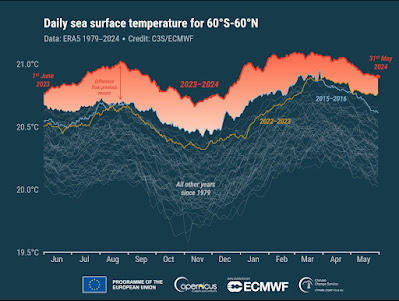
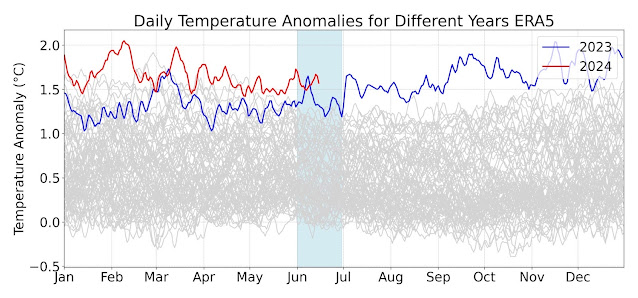
What happened in the last year Warming for the 2023 calendar year was ~1.5°C, with September above 1.8°C, the second half of 2023 at 1.67°C; and the global average temperature for the past 12 months (June 2023-May 2024) at 1.63°C above the pre-industrial baseline, according to Copernicus C3S data. Datasets of global temperatures vary a little depending on method, but two of the most significant are Berkeley Earth which put the 2023 calendar year at 1.54°C above the pre-industrial (1850-1900) level, and Copernicus/ECMWF at 1.48°C. Berkeley said that “a single year exceeding 1.5°C is a stark warning sign of how close the overall climate system has come to exceeding this Paris Agreement goal. With greenhouse gas emissions continuing to set record highs, it is likely that climate will regularly exceed 1.5°C in the next decade.” The global average temperature for May 2024 was 1.52°C above the 1850–1900 pre-industrial average, marking the eleventh consecutive month (since July 2023) for which the global average temperature reached or exceeded 1.5°C. June 2024 is very likely to be the warmest June on record. And scientists say that there is now a greater than 50% chance that 2024 will be hotter than 2023. One reason is that higher monthly temperatures are persisting (see Figure 2), even though the El Nino phase associated with higher levels of warming had finished by May 2024. (In April, the Australian Bureau of Meteorology announced that the recent El Niño was officially over because sea surface temperatures in the central Pacific Ocean have “cooled substantially”.) One or even two years of 1.5°C does not constitute a trend, which technically can only be seen in retrospect over 20 to 30 years of data, but looking back in 10 years time to see what the trend was in the mid-2020s is less useful that developing an understanding of what is happening right now.
Acceleration
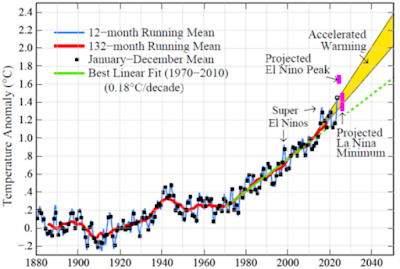
By the end of 2023, Hansen’s view was that “the 1.5 degree limit is deader than a doornail” and warns that warming will accelerate to 1.7°C by 2030 and “2°C will be reached by the late 2030s”.
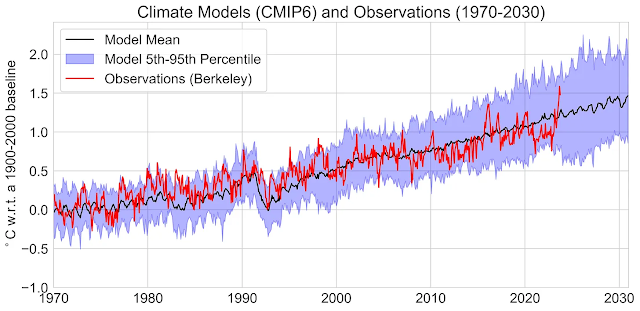
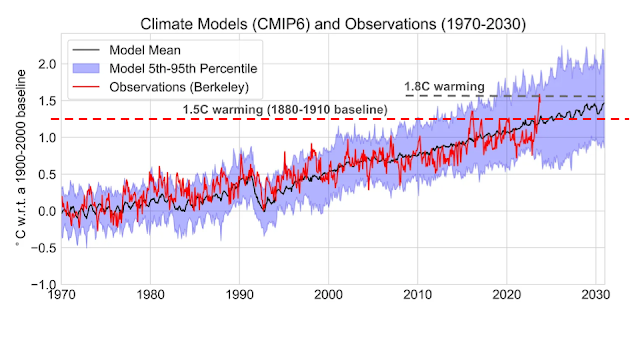
When that is done, one sees that CMIP6 actually projects a warming trend of 1.5°C level compared to pre-industrial right now! And the observations (red line) spike to 1.8°C in September 2023. Now as the 2023-24 El Nino gives way to a La Nina, global temperature will cool and the next El Nino period will very likely be higher than the 1.65°C observed in 2023-24.. In fact, says the WMO Global Annual to Decadal Update, "There is a 47% likelihood that the global temperature averaged over the entire five-year 2024-2028 period will exceed 1.5°C above the pre-industrial era”. Let’s repeat that: The World Meteorological Organisation says there is a one-in-two chance the current five-year period will exceed 1.5°C. So is the climate system, for all practical purposes, now close to a 1.5°C trend? If CMIP6 is to be taken at face value, the answer is yes. And the data now seems consistent with those models. Of course there is uncertainty as there is with all statistical work about future projections, but the precautionary principle should apply as there is no reason for delay, but rather the opposite. It is important to understand the “fat-tail” risks and the plausible worst case scenarios and act with speed to make sure they do not come true. (BY David Spratt)
Original Author: Harshit
Source:
Original Article

Geoffrey Lipman, SUNx Co-founder
info@thesunprogram.com
+32495250789